Win or Lose: Is dfcu Worth Buying While It Fights the Crane Bank Case?
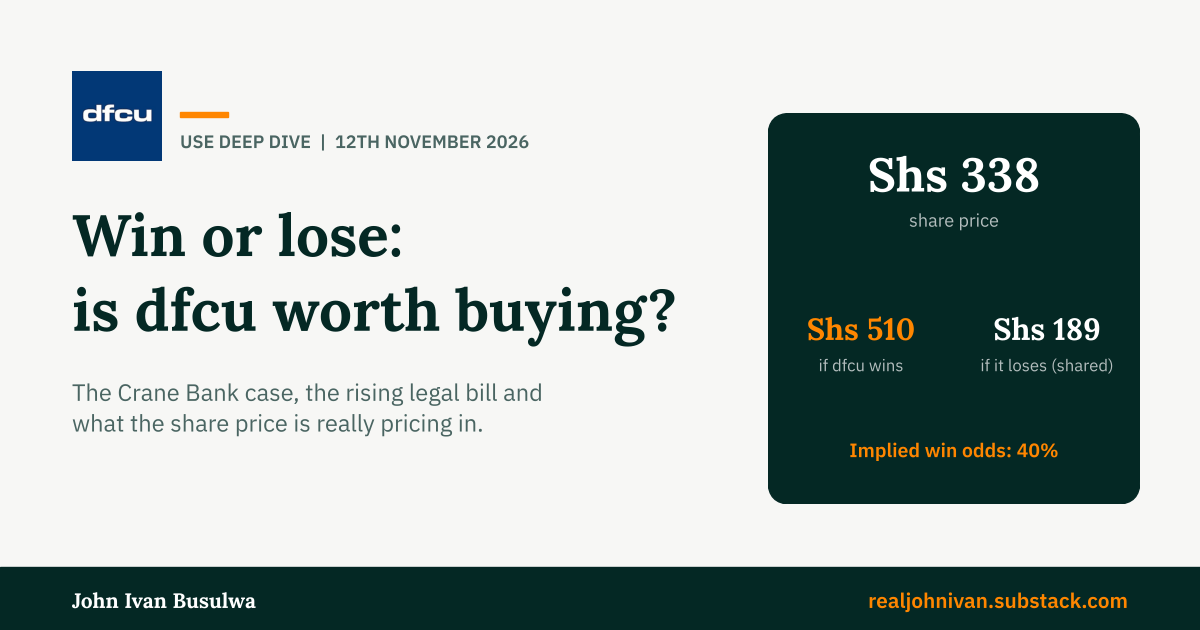
At Shs 338, dfcu's share price implies about a 40% chance of beating the Crane Bank claim in London. A win is worth Shs 510 a share; a loss with shared damages, Shs 189.

Headline valuation figures
Market close on 30 Oct 2026 (USE: DFCU)
+4% base-case fair value across four verdicts
What the market prices in before 2027 judgment
Four outcomes, four very different banks
Value per share today vs. the Shs 338 share price (mid-2027 equity rolled at 15% ROE, valued at 0.47x book)
Legal cost drag and underlying bank performance
Shs 288bn spent on the case
More than dfcu's Shs 253bn market cap: annual Crane Bank legal spend (Shs bn)
A decent bank, priced as distressed
Normalised returns add back legal costs (30% tax). Discount to Shs 755bn equity reflects the Shs 840bn claim.
Worth buying only if three things hold
You rate dfcu's win chance above 40% to 45%
Below that threshold, Shs 338 already pays too little for the binary verdict risk.
You size the position so a loss does not hurt
A full loss wipes out equity; a shared loss cuts value by about 44% to Shs 189.
You can hold through the 2027 judgment
Only 7.4m shares traded in 16 months (zero trades in Apr 2026). Exit liquidity is thin.
Model & Report Downloads
dfcu Crane Bank Financial Model
Probability-weighted equity valuation across all four trial outcomes, normalised ROE, and win-odds sensitivity. Adjust win odds, ROE, and cost recovery assumptions directly in Excel.
dfcu Crane Bank Deep Dive Report
The 18-slide deep dive: English court timeline, Shs 288bn legal bill, normalised bank value, and four court outcomes. Full deck ready to read or share.
Sponsored by Credtics
Get the next deep dive before the market moves.
Sundays. Free. One click to unsubscribe.
Independent research for education, not investment advice.
Read next
NIC shares are up 400% this year. Can Cornerstone actually turn Uganda’s oldest insurer around?
The new owners, CEO and board are real. The question is whether UGX 25 already prices in a turnaround NIC has not yet delivered.
CRDB vs NMB: Which Tanzanian bank would I rather own?
One is cheap and growing fast on borrowed funding. The other is safer and priced like it. I read three years of annual reports for each, built a model, and here is where I landed